If you have been searching for concrete contractors in Westchester County or Fairfield County, you have probably noticed how wide the quotes swing — sometimes by thousands of dollars for the same driveway, patio, or walkway. That spread is rarely about the concrete itself. It is about what happens underneath it: sub-base depth, reinforcement, drainage, and where the control joints get cut. This guide walks through what concrete work actually costs in our region in 2026, which finishes homeowners are asking for, and why early fall is one of the smartest times of year to pour.
It is the same conversation we have on driveways in Scarsdale, patios in Greenwich, and front walkways in Stamford — and it applies whether your project is a two-car driveway or a set of front steps.
Why Concrete — And Why Now
Concrete has quietly become one of the most requested surfaces in the lower Hudson Valley and coastal Connecticut. Part of that is durability math: a properly installed concrete driveway lasts 30 to 40 years in the Northeast, roughly a decade longer than asphalt, with far less recurring maintenance. Part of it is design. The 2026 trend line is unmistakable — homeowners are treating patios as outdoor rooms, with defined zones for dining, cooking, and lounging, all anchored by a durable poured surface. And instead of the busy stamped patterns of a decade ago, the requests we see lean toward subtler broom and trowel textures in warm, natural tones that sit comfortably next to stone and cedar.
Concrete is not automatically the right answer for every project. For a full comparison of the two materials on driveways specifically, see our asphalt vs concrete driveway breakdown. But for patios, walkways, steps, and garage slabs, concrete is usually the default — and for driveways it is a premium option worth pricing.
Concrete Driveway Cost in Westchester & Fairfield
National surveys put concrete driveways at roughly $8 to $20 per square foot in 2026, with the Northeast typically in the middle-to-upper half of that band once you account for our frost depth requirements. For a typical 600 to 800 square foot two-car driveway in Westchester or Fairfield County, most homeowners should budget in the low-to-mid five figures for a full removal and replacement — a broom-finished slab on a properly compacted gravel sub-base with wire mesh or fiber reinforcement.
What moves the number most is not the finish — it is the site. Removal of an existing surface, regrading for drainage, deeper excavation over poor soils, and thicker slab sections at the apron all add real cost. Decorative upgrades like stamped patterns, integral color, or exposed aggregate typically add $3 to $8 per square foot on top of a standard finish.
The honest comparison point: concrete costs more up front than asphalt, but it stretches the replacement cycle by a decade or more and never needs sealcoating on a 2-to-3-year cycle. If you are weighing both materials, our driveway installation team prices the same project both ways so you can see the lifetime math side by side.
Patios, Walkways & Steps: What They Cost
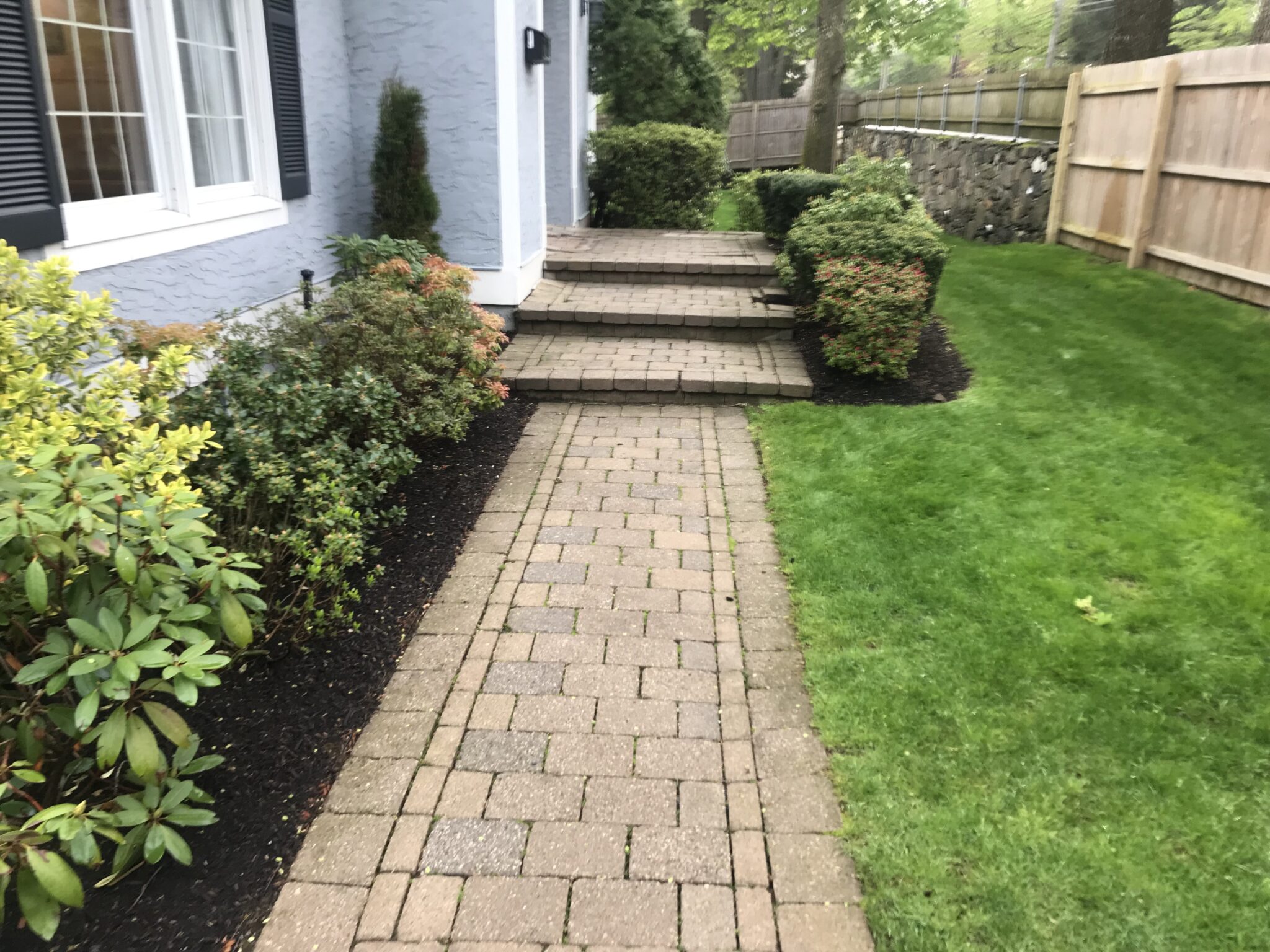
A concrete patio runs $6 to $20 per square foot in 2026 depending on finish, which puts most 300 to 400 square foot patios in the $4,000 to $8,000 range for a standard broom finish, and meaningfully more for stamped or colored work. That is consistently the least expensive way to build a large, permanent outdoor floor — comparable paver patios cost more per square foot, though pavers bring their own advantages, which we cover in our paver patio guide.
Front walkways and side paths are usually priced as small pours: expect a premium per square foot versus a driveway because mobilization, forming, and hand work dominate the job. Steps are formed and poured structural elements and are priced per riser. Because these are the surfaces guests actually touch — and the surfaces that create first impressions from the curb — this is where finishes like exposed aggregate or a picture-frame trowel border earn their keep. Our sidewalk and walkway crews handle village sidewalk replacements as well, including the permit coordination most towns in our area require.
One planning note that saves money later: if your patio or walkway sits at the bottom of a slope, solve the water first. Pouring concrete across a drainage problem locks the problem in place. We often pair pours with channel drains or regrading through our drainage solutions service so the slab sheds water instead of collecting it.
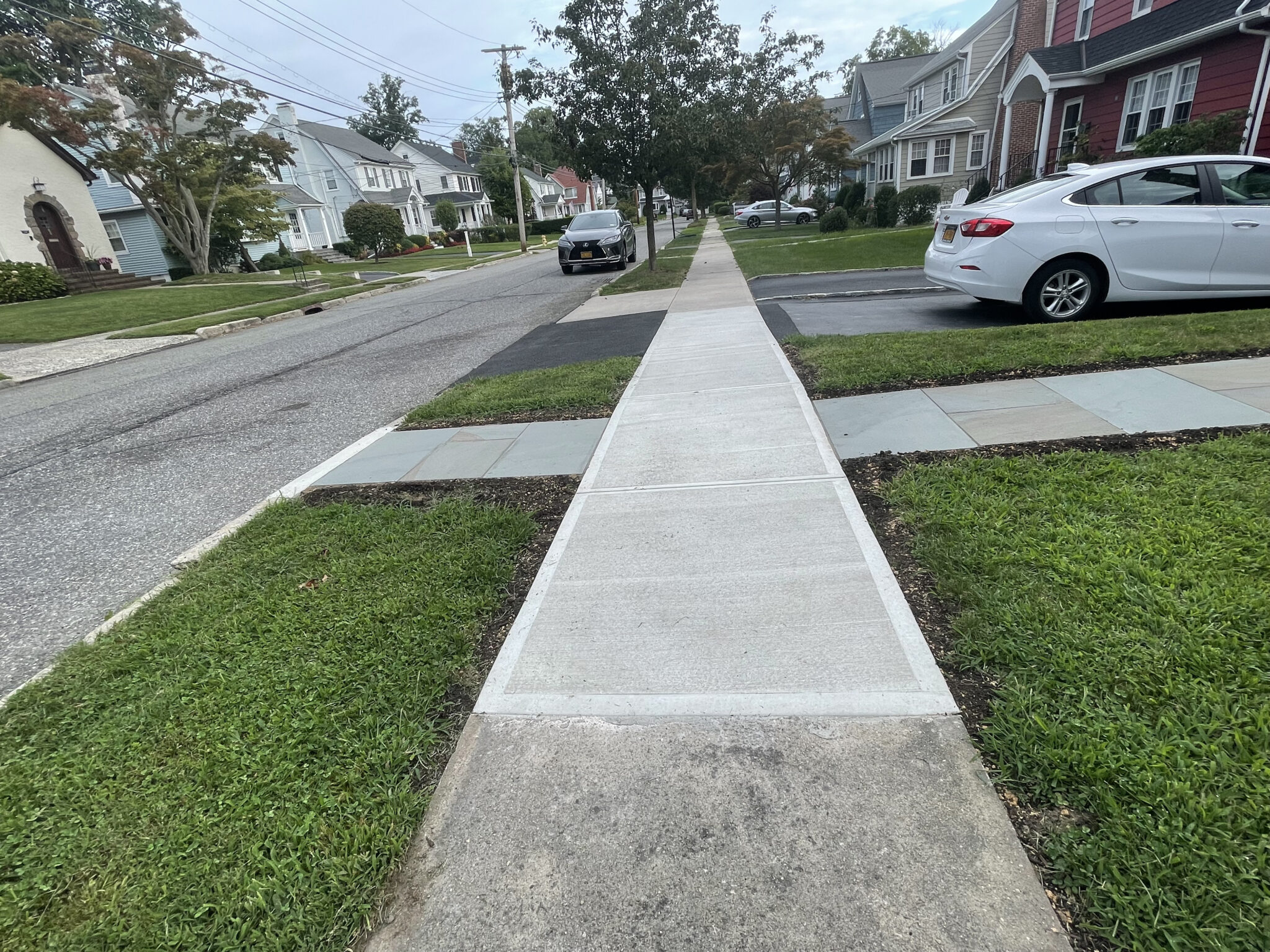
A broom finish gives concrete walkways all-season traction — essential through Northeast winters.
The Fall Pour Window: Why September Matters
Concrete cures best when air temperatures hold between 50 and 90°F. In Westchester and Fairfield County, that makes September through mid-October the last reliable pour window of the year. Days are still warm enough for steady hydration, nights have not yet dropped toward frost, and the summer humidity that can complicate finishing has eased off.
Miss the window and the risk profile changes fast. Fresh concrete that freezes in its first days loses strength it never recovers. Late-season pours can still be done with blankets, additives, and careful scheduling around overnight lows, but the margin for error shrinks and costs rise. The practical rule we follow: pour early in the day, and only when the forecast shows safe overnight temperatures for the first several nights of cure.
There is also a spring payoff to a fall pour. A driveway or patio poured in September has cured through its critical period before the first freeze-thaw cycles arrive, which means it enters winter at close to full strength. Book in late fall instead and you are usually waiting until April or May — behind every other project on the schedule.
What Separates 30-Year Concrete From 5-Year Concrete
Every failed slab we are called to replace tells the same story, and it is almost never about the concrete mix. It is about shortcuts below and around it. Four things decide whether your pour lasts:
- Sub-base preparation. Our region's frost line demands a properly compacted gravel base — pour over topsoil or loose fill and frost heave will crack the slab within a few winters.
- Reinforcement. Wire mesh or fiber reinforcement does not prevent cracking; it holds cracks tight so they stay hairline instead of opening into faults.
- Control joints, cut where they belong. Concrete will crack — the craft is deciding where. Joints at the right spacing and depth steer cracking into straight, invisible lines.
- Curing and first-winter care. Proper curing, plus one rule for year one: no de-icing salt on a first-winter slab. Use sand for traction instead.
This is the standard our crews have built to since 1999, on everything from garage slabs to full concrete driveways, patios, and structural pours across Westchester County and Fairfield County.
Thinking About a Fall Pour?
The September-to-mid-October window fills quickly because it is the last of the season. If you want a driveway, patio, or walkway poured and cured before the first frost, the time to get on the schedule is now — estimates are free and carry no obligation.
Frequently Asked Questions
How late in the year can you pour concrete in NY and CT?
Under normal conditions, mid-October is the practical cutoff for standard pours in Westchester and Fairfield County. Later pours are possible with cold-weather measures — heated mixes, insulated blankets, and strict scheduling around overnight lows — but September and early October offer the best conditions and the least risk.
How long before I can drive on a new concrete driveway?
Foot traffic is fine after 24 to 48 hours. Keep passenger vehicles off for at least 7 days, and heavy vehicles like delivery trucks off for a full 28 days, which is when concrete reaches its design strength.
Is stamped concrete worth it compared to pavers?
Stamped concrete usually costs less than a comparable paver installation and gives a continuous, low-maintenance surface. Pavers cost more but can be individually reset if the base ever shifts. In freeze-thaw country, both live or die by base preparation — which is why we treat the excavation and compaction phase as the real product.
Do concrete driveways need sealing?
Yes, but far less often than asphalt needs sealcoating. A penetrating siloxane sealer every 3 to 5 years protects concrete from de-icing salt and freeze-thaw moisture, and decorative finishes benefit from resealing on a similar cycle to keep their color.
Ready to price your concrete project before the fall window closes? Get your free estimate from JL Construction today — (203) 658-6744.