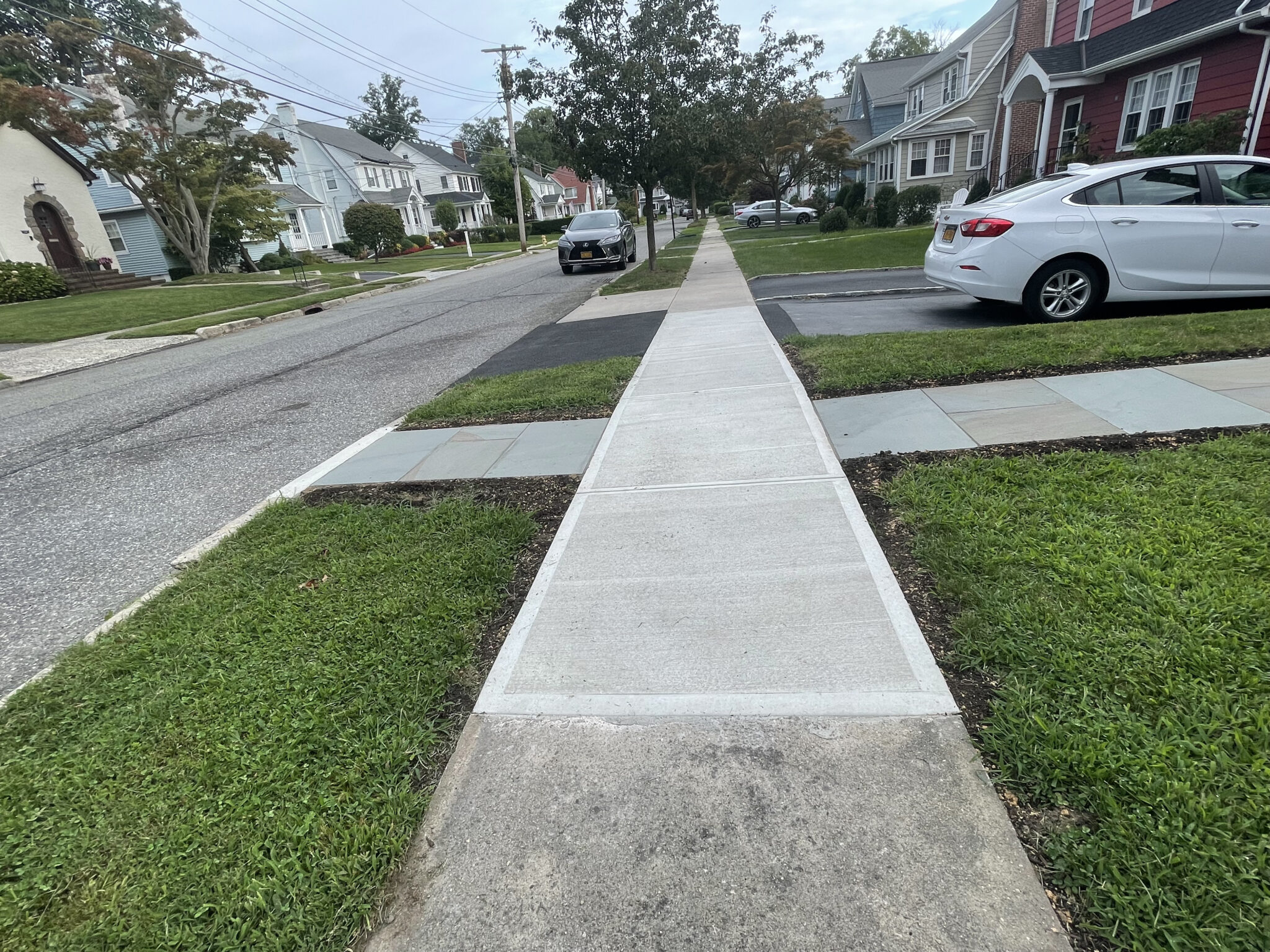
Most property owners never think about the concrete in front of their house until someone trips on it. Sidewalk repair in Westchester County and Fairfield County is one of those jobs that sits quietly on the to-do list for years — a lifted slab here, a spidered panel there — until a neighbor stumbles, a town inspector leaves a notice, or a winter of freeze-thaw turns a half-inch lip into a genuine hazard. By then the conversation has changed from maintenance to liability.
JL Construction Group has been pouring and repairing concrete walks across New York and Connecticut since 1999. This guide covers what we actually see in the field: who is legally on the hook for the walk adjacent to your property, how to judge whether a panel can be repaired or needs to come out, what the work costs in our region in 2026, and why late summer through fall is the right time to book it.
Who Is Responsible for the Sidewalk in Front of Your Property?
This is the first question almost every homeowner asks, and the honest answer is that it depends on your municipality — but the default across most of Westchester and Fairfield puts the burden on the adjacent property owner.
Westchester County municipalities generally require property owners to keep the sidewalk abutting their home or commercial building in good repair. Many Connecticut towns follow the same pattern, with local ordinances assigning maintenance and, in some cases, liability for injuries caused by a defect the owner knew about or should have known about. Some towns cost-share on replacement, some run periodic inspection sweeps, and a handful handle repairs themselves and bill the owner.
The practical takeaway is the same regardless of which column your town falls into: a raised slab or a crumbling panel in front of your property is your problem to solve, and solving it before an incident is dramatically cheaper than solving it afterward. Before scheduling work, call your building or public works department — some towns require a permit for sidewalk replacement, and a few specify slab thickness, jointing, or apron detail. A contractor who works in your town regularly will already know. Our guide on how to choose a paving contractor covers the questions worth asking before you sign anything.
The Half-Inch Rule
A vertical difference of roughly half an inch between adjacent slabs is the threshold most inspectors and insurers treat as a trip hazard — and it is also the ADA standard for accessible routes on commercial property. If you can catch the edge of your shoe on it walking normally, it is past the point of "we will get to it eventually."
Why Northeast Sidewalks Fail: Roots, Water, and Freeze-Thaw
Concrete sidewalks in our climate almost never fail because the concrete was weak. They fail because of what is happening underneath them.
Tree roots are the single most common cause we encounter in Westchester and coastal Fairfield, where mature street trees line most residential blocks. A maple or oak root running under a four-inch slab will lift it as the root thickens, and no amount of surface patching will hold against that pressure. The fix requires removing the slab, cutting or shaving the offending root where it can be done without killing the tree, restoring the base, and repouring — sometimes with a thicker section or a root barrier.
Water and the freeze-thaw cycle do the rest. Water that gets under a slab through an open joint or a settled base saturates the subgrade. When it freezes it expands about nine percent, heaving the slab; when it thaws the slab drops back, but not always to the same place. Our region swings above and below freezing dozens of times each winter, and every one of those cycles moves the concrete a little more. Add road salt — which increases the number of cycles and attacks the surface paste directly — and you get the scaling, spalling, and edge crumbling we see on so many walks by their fifteenth winter.
A failed base is the quiet one. If the original walk was poured on unimproved soil rather than a compacted stone base, it was destined to settle. This is the same principle that governs every flatwork surface we install — it is why our concrete driveways and patios guide spends more time on what goes under the slab than on the slab itself, and why unresolved drainage problems shorten the life of everything above them.
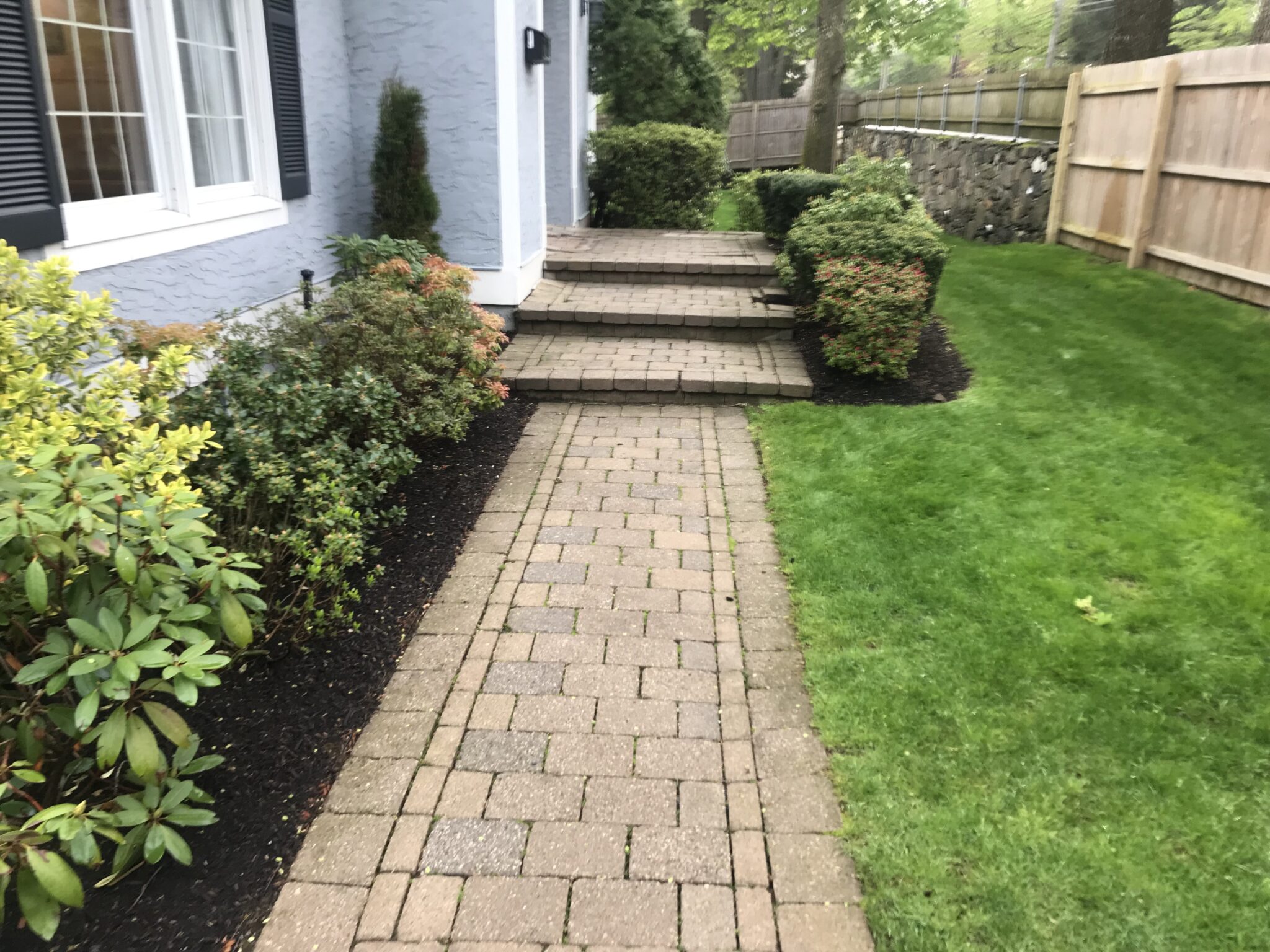
A properly based and jointed walk will outlast a thicker slab poured on soft ground.
Repair or Replace? How to Read Your Sidewalk
Concrete sidewalks are poured in panels for a reason: damage can usually be addressed one panel at a time. Here is how we triage a walk during an estimate.
- Hairline surface cracks, tight and stable. Cosmetic. Seal the joint, monitor annually, and leave it alone. Chasing every hairline is money badly spent.
- A single settled panel with no cracking. Sometimes a candidate for slab lifting, where polyurethane foam or grout is injected to raise it back to grade. Fast and inexpensive when the slab itself is sound and the cause of the settlement has been fixed.
- A lifted or tipped panel over a root. Replacement of that panel, plus root treatment. Grinding the lip is a legitimate short-term measure to remove the trip hazard, but it does not stop the root.
- Cracked into three or more pieces, or rocking underfoot. The panel is done. Structural cracks mean the section has lost its load path; patching compound will not restore it.
- Widespread scaling and spalling. Surface deterioration from salt and freeze-thaw. If it is shallow and localized, resurfacing can buy years. If aggregate is exposed across most panels, budget for full replacement.
- More than about half the panels compromised. At that point replacing the whole run costs less per square foot than picking off panels individually, and you get a uniform surface and consistent jointing instead of a patchwork.
Full replacement is also the moment to reconsider the material. Poured concrete is the default for public-facing walks, but brick pavers on a proper base flex with ground movement instead of cracking, and individual units can be lifted and reset years later. For front walks and entries where appearance carries weight, bluestone and other masonry and stonework options change the character of an entire frontage. Both belong in the conversation when you are already paying for demolition and base prep.
What Sidewalk Repair Costs in Westchester and Fairfield
National figures put typical sidewalk repair in the range of roughly $700 to $2,500, with new concrete running about $7 to $17 per square foot installed before demolition and site work. Our region sits at the upper end of those ranges, and for reasons that are worth understanding rather than just absorbing.
Labor and disposal costs in the New York and Connecticut metro corridor are higher than the national average. Many older walks in White Plains, New Rochelle, and Stamford sit tight against street trees, utility boxes, and gas services, which means hand excavation instead of machine work. Municipal specifications may require a deeper section or specific jointing. And access matters — a walk a truck can reach costs less than one behind a narrow side yard.
The variables that move a quote the most, in order: the number of panels, whether roots have to be dealt with, how much base has to be rebuilt, disposal volume, and whether a permit and inspection are required. A reputable estimate will separate those line items rather than handing you one number. If the walk work is part of a larger frontage project, pricing usually improves — our breakdown of driveway paving costs in Westchester and Fairfield shows how mobilization costs get spread across combined work.
The Fall Window: Why Timing Matters for Concrete
Concrete is temperature-sensitive in both directions. Poured in July heat it can flash-set, losing workability before it is properly finished. Poured too late in the season it cannot develop strength before freezing — fresh concrete that freezes in its first days can lose a substantial share of its ultimate strength permanently, and no amount of curing later undoes it.
That makes early fall the best pour window of the year in our climate: mild days, cool nights, low risk of flash-setting, and enough runway before hard frost for the slab to reach meaningful strength. Practically, that means booking sidewalk work between late August and roughly the end of October across Westchester and Fairfield, with the exact cutoff depending on the year. The same seasonal logic governs asphalt work — see our notes on fall crack sealing and the best time to pave a driveway. Crews book out in fall; a call in September gets scheduled, a call in mid-November usually gets a spring date.
Commercial Property: Sidewalks Are a Liability Line Item
For a retail plaza, office building, condo association, or municipal property, walkway condition is not a curb appeal question — it is risk management. Trip-and-fall claims are among the most common premises liability actions, and an uneven walk in a customer path is the kind of defect that is trivially easy to document after the fact. ADA accessible-route requirements add a second layer: changes in level above a quarter inch need beveling, and above half an inch need a ramp. We handle walkway condition alongside parking lot surfaces for commercial clients across both counties, because the two usually deteriorate on the same timeline and cost less to address in one mobilization. Our guide to commercial parking lot care covers the pavement side of that program.
Frequently Asked Questions
How long does a concrete sidewalk last?
A properly installed concrete walk on a compacted stone base typically gives 25 to 40 years in our climate. The variables that shorten that are almost always base quality, drainage, and nearby tree roots rather than the concrete mix. Walks that get sealed periodically and are not buried in rock salt every winter reliably land at the upper end of that range.
Can an uneven sidewalk be fixed without replacing it?
Often, yes. If the slab is structurally sound and has simply settled, slab lifting can raise it back to grade at a fraction of replacement cost. If the lift is caused by a root pushing from below, grinding the raised edge removes the immediate trip hazard but is a temporary measure — the root keeps growing. We will tell you plainly which situation you are in during the estimate.
Do I need a permit to replace my sidewalk?
In many Westchester and Fairfield municipalities, yes — sidewalks typically sit within the public right-of-way even when the abutting owner is responsible for maintaining them. Requirements vary considerably by town. We pull the permits and handle the inspection coordination on the jobs we do, which is one of the reasons hiring locally matters for this particular kind of work.
How long before I can walk on a new sidewalk?
Foot traffic is generally fine after 24 to 48 hours depending on temperature, and vehicle traffic over a driveway apron should wait seven days or more. Concrete continues gaining strength for weeks after that. We will barricade the section and give you specific timing for your pour and the weather that week — and we ask that de-icing salt be kept off any new concrete through its first winter, which is the single most common cause of premature surface scaling.
Get a Straight Answer on Your Sidewalk
JL Construction Group has installed and repaired sidewalks and walkways, concrete flatwork, and driveways across Westchester County, NY and Fairfield County, CT since 1999 — from Scarsdale and Yonkers to Greenwich, Darien, and Westport. We will walk the frontage with you, mark what genuinely needs to come out versus what can wait, confirm what your town requires, and put the whole thing in writing before anyone breaks concrete.
The fall concrete window is open now. Request your free sidewalk repair estimate from JL Construction Group today.